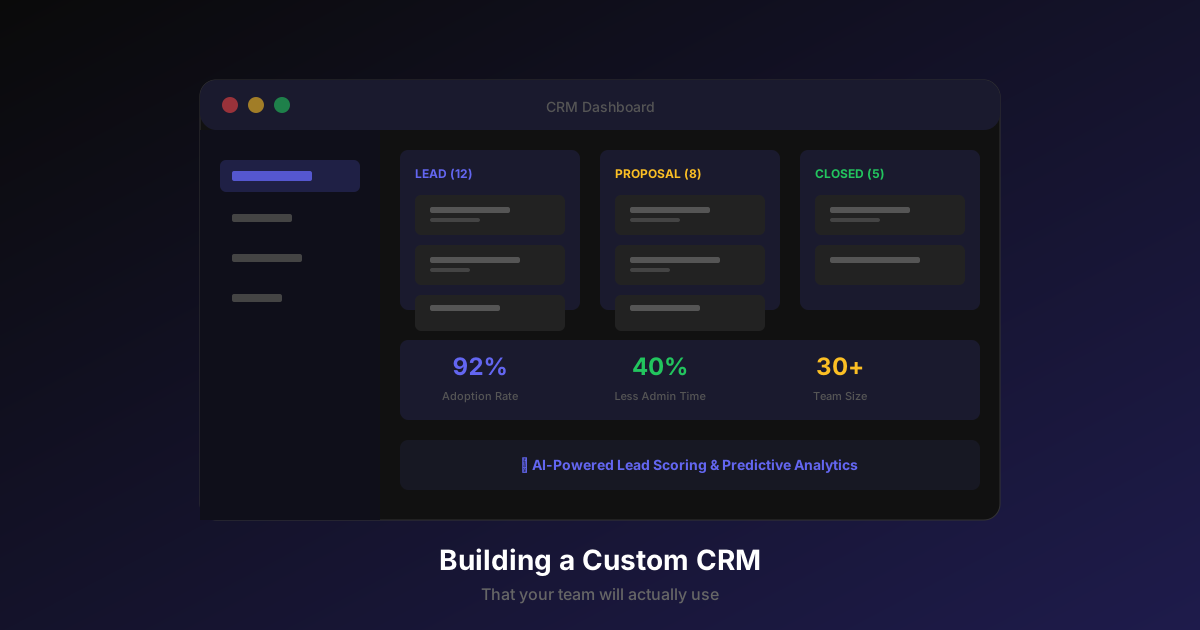
Building a Custom CRM That Your Team Will Actually Use
Every growing business eventually hits the same wall: the CRM that worked at 10 employees becomes a bottleneck at 50. Salesforce is too complex. HubSpot is too expensive at scale. And every off-the-shelf solution forces your team to adapt their workflow to the software instead of the other way around.
The result? Your sales team avoids using the CRM entirely. They track deals in spreadsheets, follow up from memory, and your management has zero visibility into the pipeline. The CRM becomes an expensive database that nobody trusts.
Why Custom CRMs Get Adopted
A custom CRM is built around your actual sales process. Your pipeline stages, your lead scoring model, your reporting requirements — not generic defaults. When the CRM matches how your team actually works, adoption rates jump from the typical 40% to above 90%.
The key insight is that CRMs fail because of UX, not features. Your team doesn't need 200 features they'll never use. They need 20 features that are perfectly designed for their daily workflow. A custom CRM strips away the noise and focuses on what actually drives revenue.
AI Integration: The Real Power Multiplier
The real power of a custom CRM comes from AI integration. Imagine a system that automatically scores leads based on your historical conversion data, drafts follow-up emails in your brand voice, and alerts sales reps when a deal goes cold. These aren't futuristic features — they're achievable with current AI APIs and a well-architected backend.
AI-powered lead scoring analyzes patterns in your closed deals — company size, industry, engagement history, source channel — and assigns a probability score to new leads. Your reps spend their time on the deals most likely to close, instead of chasing every inbound inquiry equally.
Predictive analytics can forecast revenue, identify at-risk accounts, and suggest optimal follow-up timing based on historical patterns. When your CRM proactively tells you which deals need attention, your close rate improves without adding headcount.
Building It: Timeline and Architecture
Building a custom CRM doesn't mean starting from scratch. Modern platforms let you assemble CRM components — contact management, deal tracking, email integration, reporting dashboards — using reusable modules. A focused MVP can be built in 4–6 weeks, with continuous iteration based on user feedback.
The typical tech stack for a custom CRM: Next.js for the frontend (fast, SEO-friendly, great developer experience), PostgreSQL for the database (reliable, handles complex queries), and a service like Resend or SendGrid for email integration. Total infrastructure cost: under $100/month for most teams.
The Cost Math
The total cost of ownership often favors custom over time. While a SaaS CRM charges per seat monthly forever, a custom CRM is a one-time build cost with minimal ongoing maintenance. For a team of 30+ users, the break-even point is typically within 18 months.
Consider the numbers: Salesforce charges $75–$300/user/month. For a 30-person team, that's $27,000–$108,000 per year. A custom CRM MVP costs $15,000–$40,000 to build with $50–200/month in hosting. Within two years, you've saved enough to fund a major feature expansion — and you own the software outright.
The real question isn't "can we afford a custom CRM?" — it's "can we afford the lost productivity, missed follow-ups, and blind spots that come with a CRM our team doesn't use?"
Related Articles
Why Custom Websites Outperform Templates for Growing Businesses
Template sites limit your brand and SEO potential. Discover why custom-built websites with Next.js and headless CMS deliver 3× faster load times and higher conversion rates.
Mobile AppsCross-Platform Mobile Apps in 2026: React Native vs Flutter
Choosing the right framework for your mobile application. We break down performance, developer experience, and time-to-market for both stacks.
Void AIHow Void AI Agents Are Transforming Enterprise Operations
Autonomous AI agents that handle scheduling, data entry, and customer routing — without human intervention. See how Void AI powers the next generation of business automation.
Have a project in mind? Let's talk.
Get a Quote